The Rumtopf That Crossed an Ocean: Our Family’s Christmas Fruit Tradition
Our family Rumtopf tradition is a cherished piece of culinary history, spanning generations, crossing an ocean, and preserving the flavours of our family’s orchard harvests. At its heart is a magnificent ceramic Rumtopf that my Oma and Opa brought from Russia to Canada in 1924.
In our family, one of those treasures is an enormous, beautiful ceramic Rumtopf that my Oma and Opa brought with them when they fled Russia and came to Canada in 1924.
That same Rumtopf became a fixture of my childhood, an ongoing project in our fruit cellar, and eventually a tradition I continued myself as an adult.
It has a remarkable history: the journey across an ocean, my grandparents’ orchards in Niagara-on-the-Lake, my mother’s preparations, Opa’s playful German song, and the delicious fruits I occasionally sneaked out of the cellar with a spoon!
This is the story of our family’s Rumtopf tradition, and why its flavours and memories remain so precious to me.
What Is a Rumtopf? Our Family Rumtopf Tradition
Rumtopf is German for “rum pot.” Traditionally, it refers to seasonal fruits preserved in rum and sugar, usually in a substantial glazed stoneware crock.
In many German-speaking households, Rumtopf is prepared gradually throughout the growing season. As fruits ripen, they’re added to the pot with rum and sugar, and the flavours develop together over several months.
By Christmas, the crock contains a wonderfully fragrant combination of rum-soaked fruit and richly flavoured liquid, ready to serve with desserts or enjoy as a special seasonal treat.
Traditional Rumtopf can contain cherries, berries, plums, apricots, peaches, pears, and other suitable fruits. The particular combination depends on the harvest, the household, and the family’s traditions.
Our version was a little different from many published recipes. We used a great deal of dehydrated fruit, supplemented it with fresh seasonal fruit, and, as my mother has now confirmed, we never added extra sugar.
Our Family Rumtopf Heirloom Crosses an Ocean
I recently asked my mother, Ingrid, where our beautiful family Rumtopf originally came from.
Was it a wedding gift? Had someone given it to her? Or had it been passed down through the family?
Her answer was extraordinary.
My Oma and Opa brought that very Rumtopf with them when they fled Russia and immigrated to Canada in 1924.
Imagine that.
Among the possessions they carried with them as they began a new life in another country was this beautiful piece of ceramic kitchenware.
I don’t know every detail of the crock’s earlier history, but I do know that it became a treasured and well-used part of our family’s life in Canada.
And more than a century later, its story is still being told.
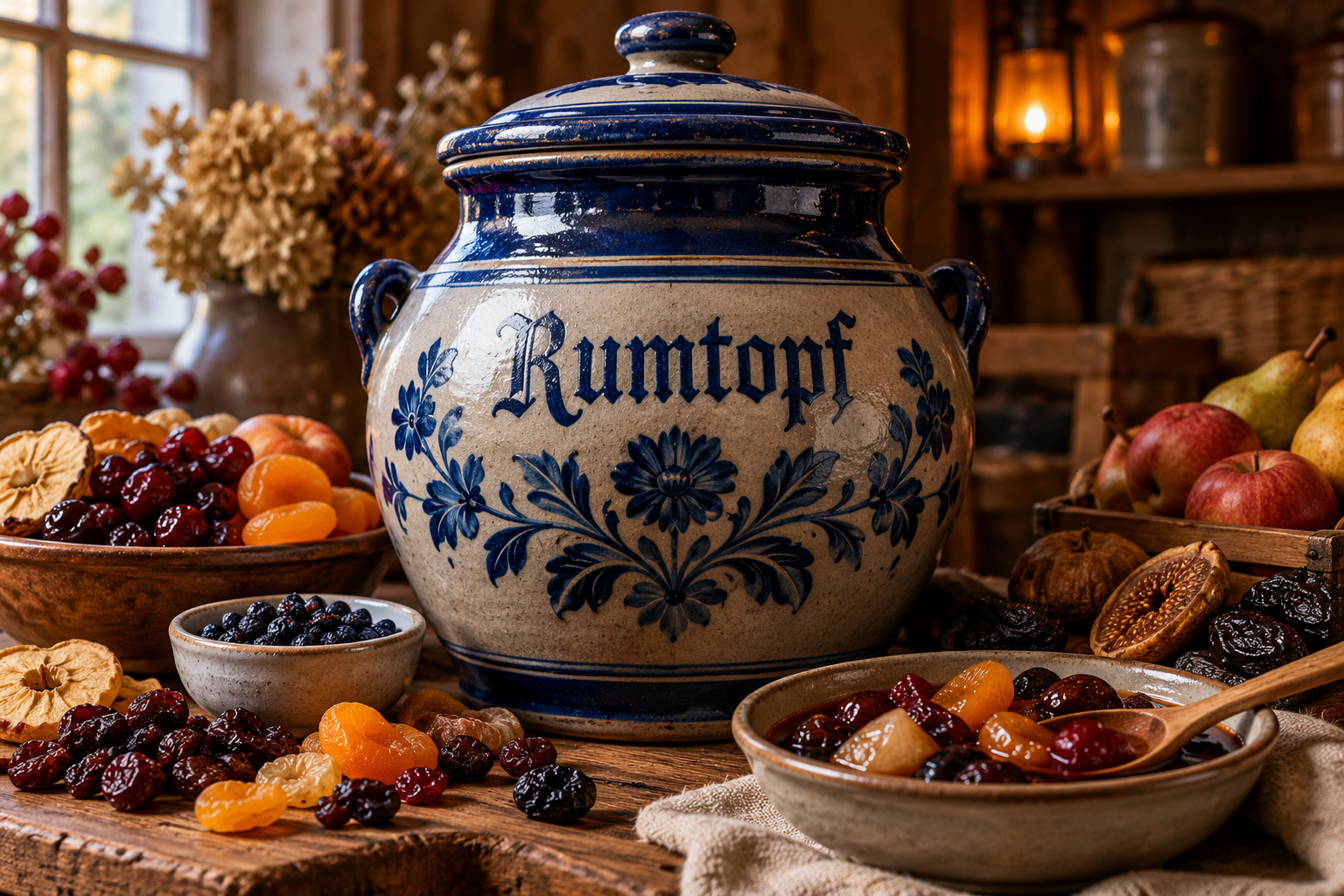
Our Enormous Navy-Blue and Stoneware Rumtopf
Our Rumtopf was an absolute beauty!
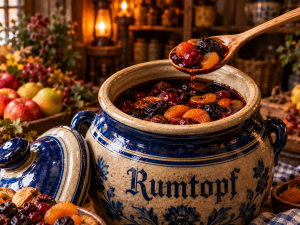
Standing approximately eighteen inches tall, it was a substantial, curvaceous stoneware vessel.
Its shape narrowed toward the base, swelled into a large rounded belly, and curved inward again at the top beneath a beautiful, close-fitting lid.
The glaze was a gorgeous combination of deep blue—a colour somewhere between navy and cobalt—and a soft beige-gray stoneware colour.
And across the front, prominently displayed, was the word RUMTOPF.
She really was magnificent.
And she wasn’t just for decoration. This was a working family Rumtopf, used year after year to prepare and enjoy wonderful rum-preserved fruits.
In fact, she had to be large. My grandparents raised nine children, meaning there were eleven people in their household, not counting the guests who might join them!
That great big Rumtopf was helping serve a great big family.
Opa’s Little German Rumtopf Song
One of the loveliest memories my mother shared while we were talking about the Rumtopf was that my Opa used to sing a little German rhyme when Oma was preparing it.
Opa was a musical man. He sang in a German choir and played guitar, and Mom remembers that he had a wonderful sense of rhythm.
Apparently, preparing the Rumtopf sometimes came with its own musical accompaniment!
Mom remembered several fragments of the song, including “unser Rumtopf” (“our Rumtopf”), the word “kommt” (“comes”), and a humorous comparison to a “Trommeltopf” or drum-pot.
We spent some time piecing together the fragments she remembered, and Mom believes the following reconstruction is very close to what Opa sang:
Morgen kommt unser Rumtopf,
Unser Rumtopf, unser Rumtopf!
Ist nicht groß, ist ziemlich klein,
Wie ein kleiner Trommeltopf!
English translation:
Tomorrow comes our Rumtopf,
Our Rumtopf, our Rumtopf!
It’s not big, it’s rather small,
Like a little drum-pot!
Family-history note: These German lines are a tentative reconstruction from Ingrid’s remembered words and rhythm, not a verified historical transcription. Mom recognizes the refrain and believes this version is close to the song Opa sang.
What makes that little rhyme especially amusing is the reference to a small pot, because our actual Rumtopf was enormous!
I love imagining Opa singing his cheerful little song while Oma worked with the fruit.
It’s such a delightful reminder that family food traditions aren’t only about ingredients and cooking methods. They’re also about the little jokes, songs, conversations, and rituals that accompany everyday life.
Kasper Family Orchards and Our Family Rumtopf Tradition
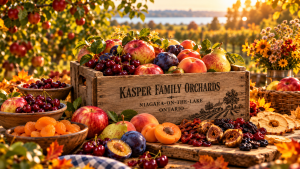
Much of the fruit that filled our Rumtopf came from Kasper Family Orchards, my Oma and Opa’s farm at RR #3, Four Mile Creek Road, in Niagara-on-the-Lake, Ontario, Canada.
It was a working family orchard, and practically everyone in our enormous family spent time helping there.
Oma and Opa had nine children, and eventually there were 27 grandchildren.
I was grandchild number 27—the youngest—and even I worked the farm!
Many of our older second cousins worked there, too.
We picked fruit, sorted it, packed it, and made the masters, the boxes used for packing the harvest.
Working in the orchards was simply part of family life.
Those beautiful fruits didn’t just appear on our table. They represented the work of generations of family members, gathering and preparing the harvest.
Our family Rumtopf tradition was closely connected to those orchard harvests. Some of the beautiful fruit we picked and packed eventually found its way into our magnificent Rumtopf.
Orchard Harvests for Our Family Rumtopf
We had access to an incredible variety of seasonal fruits.
There were wonderful stone fruits from the farm, including plums, cherries, apricots, and peaches, along with apples and pears.
As the growing season progressed, fruit was brought home, enjoyed fresh, preserved, dehydrated, or prepared in any number of delicious ways.
And, of course, some of it went into the Rumtopf.
Sometimes Mom used fresh fruit. Other times, she used dried or dehydrated fruit, depending on the season and the ingredients available.
I remember a wonderful assortment of dried fruits in particular:
- Raisins
- Dried apricots
- Dried cherries
- Dried blueberries
- Dried kiwi
- Dried peaches
- Dried apples
- Dried pears
- Nectarines
- Figs
- Plums and prunes
- And possibly dates, although I can’t remember those with certainty
We certainly weren’t limited to one or two fruits!
The dried fruit contributed intense, concentrated sweetness and flavour, while also giving some of the more delicate fruits a firmer texture before they began soaking in rum.
As the ingredients absorbed the rum and the flavours mingled, the contents of the crock became a wonderfully complex combination of fruit, sweetness, and rich rum aroma.
Why Our Family Rumtopf Recipe Never Included Sugar
One detail about our Rumtopf that I remembered quite clearly was that we didn’t add sugar.
Before writing this article, I checked with Mom, and she confirmed it.
Our family Rumtopf did not contain added sugar.
Oma and Opa were raising nine children, and they weren’t wealthy people.
Mom remembers that they would not have used additional sugar unnecessarily, particularly when so much of the fruit was already naturally sweet.
Dehydrating fruit concentrates its natural sugars, so raisins, prunes, dried apricots, cherries, and other dried fruits provided plenty of sweetness and character.
Our family’s preparation used strong rum and the fruit itself, rather than the substantial quantities of added sugar found in many conventional Rumtopf recipes.
That’s an important distinction.
I’m not suggesting that all traditional German Rumtopf is made without sugar. In fact, many established recipes specifically call for sugar as part of the preserving method.
I’m simply documenting the way our family prepared it, as both Mom and I remember.
That resourcefulness became an important part of our family Rumtopf tradition, reflecting the practical approach to food and family life that my grandparents passed down through the generations.
Our Family Rumtopf Tradition Through the Seasons
Our Rumtopf wasn’t something I remember being completely emptied and started from scratch every year.
As I recall it, there was always something happening inside that crock.
Fruit was added as the seasons progressed. Some was enjoyed, new fruit arrived from the orchards, and the contents continued to evolve.
I’m not sure that the Rumtopf was ever entirely empty!
There was a wonderful sense of anticipation about it, especially as the year drew toward Christmas.
By then, all those fruits had developed an extraordinary flavour, combining the concentrated sweetness of the dried fruit with the richness of the rum.
Important preparation note: This description preserves our family’s historical practice. It isn’t a recommendation to maintain a continuously replenished Rumtopf indefinitely. Alcohol concentration, fruit moisture, cleanliness, and storage conditions all affect food safety. For modern home preparation, use a reliable fresh-batch method with appropriate proportions and handling instructions.
Sneaking into the Fruit Cellar with a Spoon!
Now, I have a little confession.
When I was a child, and even as a teenager, I sometimes sneaked down into our fruit cellar with a spoon in hand.
And yes, I was headed straight for the Rumtopf!
I remember how delicious those fruits were, how the flavours had mingled together, and how tempting it was to lift the lid and steal a little taste.
That rich combination of dark fruit, concentrated sweetness, and rum was simply irresistible to me.
Of course, Rumtopf contains alcohol, including in the fruit itself, and is intended for adults. My childhood escapades are a family memory, not something I’d recommend children repeat.
But those flavours stayed with me. Our family Rumtopf tradition created memories that have followed me from childhood into adulthood.
In fact, I sometimes wonder whether those memories help explain why rum-raisin ice cream remains one of my favourite flavours.
Continuing our family Rumtopf tradition in that same beautiful stoneware crock made every new preparation feel connected to the generations before me.
Continuing Our Family Rumtopf Tradition as an Adult
My family’s Rumtopf tradition didn’t end when I grew up.
As an adult, I continued preparing Rumtopf myself, using the very same beautiful stoneware crock my grandparents had carried across the ocean.
It remained an ongoing kitchen tradition, with fruit added throughout the seasons and the flavours developing together over time.
There’s something especially meaningful about continuing a family food tradition in the very same vessel that has been used for generations.
Whenever I think of that Rumtopf, I remember Oma and Opa, Mom, the orchards, the fruit cellar, and the many members of our family who contributed to the harvests.
Kasper Family Orchards has since been sold, but the traditions and memories from that farm are still very much alive.
How to Enjoy Our Family Rumtopf: Serving Ideas
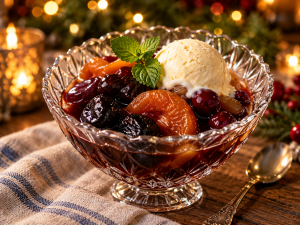
One of the wonderful things about Rumtopf is its versatility.
Those richly flavoured, rum-infused fruits can be enjoyed in so many ways, whether as a simple adult dessert or as an accompaniment to traditional Christmas baking.
Here are some delicious ideas:
1. Serve Rumtopf on Its Own
Spoon some of the fruit and its fragrant liquid into a small dessert bowl and enjoy it as a special after-dinner treat.
2. Serve It Chilled or Gently Warmed
Rumtopf can be enjoyed cool, or a serving can be warmed gently for a comforting winter dessert. Remember that warming does not reliably eliminate the alcohol.
3. Spoon It Over Ice Cream
Vanilla ice cream is a natural pairing, but I especially love the thought of serving Rumtopf with rum-raisin ice cream!
4. Serve Rumtopf with Custard
The richly flavoured fruit is wonderful alongside smooth vanilla custard, whether warm or chilled.
5. Add It to Rice Pudding
A spoonful of Rumtopf can transform a simple bowl of creamy rice pudding into an indulgent adult dessert.
6. Try It with Tapioca Pudding
The soft, creamy texture of tapioca pairs beautifully with the rich flavours and contrasting texture of rum-soaked fruit.
7. Serve It Alongside Pies and Pastries
Rumtopf makes a delicious accompaniment to fruit pies, pastry-topped desserts, turnovers, and other baked treats.
8. Spoon It Over Cake or Cheesecake
Try Rumtopf over pound cake, sponge cake, cheesecake, or a simple slice of butter cake.
9. Use It with Traditional Fruit Desserts
A little Rumtopf could make an interesting adult accompaniment to traditional fruit dishes, including Pluma Moos, the German-Mennonite fruit soup or stew made with dried fruits. Keep the original dish separate if serving children or anyone avoiding alcohol.
10. Pair It with Bread Pudding
Warm bread pudding and rum-infused fruit make a particularly comforting Christmas dessert combination.
11. Drizzle the Rumtopf Liquid Over Desserts
The liquid develops a wonderful fruity character as it infuses. A small drizzle can complement suitable adult desserts, even when the fruit is reserved for something else.
12. Make a Rumtopf Cocktail!
And here’s a delicious idea we’re developing for Cooking With Kimberly: The Rumtopf Royale!
Imagine a couple of spoonfuls of rum-soaked fruit muddled in a cocktail shaker, combined with complementary ingredients, shaken vigorously over ice, and strained into a beautiful cocktail glass.
It’s a lovely way to transform this old family tradition into a completely new Christmas cocktail.
We’ll be sharing our original Rumtopf Royale recipe separately.
13. Add Rumtopf to a Christmas Charcuterie Board
For an elegant Christmas or holiday charcuterie board, serve a small bowl of Rumtopf fruit alongside a beautiful assortment of cheeses, cured meats, crackers, nuts, and other accompaniments.
The rich, fruity sweetness of the rum-preserved fruit provides a wonderful contrast to salty, savoury flavours. Try pairing it with aged cheddar, Gouda, Brie, Camembert, blue cheese, or other favourite cheeses.
Add some toasted walnuts, pecans, crusty bread, crisp crackers, and perhaps a few fresh grapes or sliced pears for a truly delicious holiday presentation.
Use a small serving bowl with its own spoon, allowing guests to enjoy a little Rumtopf alongside their favourite combinations.
Because Rumtopf contains alcohol, clearly identify it as an adults-only accompaniment and offer a separate non-alcoholic fruit preserve for guests who prefer one.
14. Make Rumtopf Fruit Leather for Unique Holiday Gifts
Here’s another intriguing way to enjoy Rumtopf: turn those richly flavoured fruits into homemade fruit leather!
Imagine blending a portion of your rum-preserved fruit into a smooth, intensely fruity purée, then spreading it thinly on a suitable dehydrator tray to create a wonderfully distinctive fruit roll-up.
With flavours of cherries, apricots, plums, peaches, pears, figs, and other fruits mingling together, the possibilities are delicious!
These could make a fascinating addition to an adult holiday gift basket, especially when paired with homemade preserves and other seasonal specialties.
Important: Dehydration does not guarantee that all alcohol has been removed. Rumtopf fruit leather should therefore be considered an alcoholic, adults-only preparation. A tested drying method and appropriate storage guidance would also be needed before preparing it for gifting.
We’ll explore this idea further as a separate Cooking With Kimberly recipe once we’ve tested the preparation.
Keeping Our Family Rumtopf Tradition Alive
For many families, Rumtopf is a way of capturing the flavours of summer and enjoying them during the Christmas season.
For our family, it meant so much more.
Those fruits represented Oma and Opa’s orchards, the work of a large family, Mom’s resourcefulness, and the excitement of discovering what was waiting beneath the lid of that magnificent crock.
I remember Opa singing his little German song while Oma prepared the fruit.
Imagine eleven people around the family table, sometimes joined by guests, enjoying the bounty of the harvest.
And somewhere among those memories is a little girl sneaking into the fruit cellar with a spoon!
Above all, I treasure the story of a beautiful piece of stoneware that crossed an ocean with my grandparents and eventually became part of my own kitchen traditions.
Food traditions are living family history.
Recipes preserve methods and ingredients, but the stories behind those recipes preserve the people, places, and memories that make food so meaningful.
I’m grateful to my mother, Ingrid, for helping me recover more of this remarkable family story, including the history of the crock and the little song her father used to sing.
And I’m delighted to share a little of our Rumtopf tradition with you.
Explore More German Recipes & Reviews on Cooking With Kimberly
If you enjoyed learning about our family’s century-old Rumtopf tradition, explore more delicious German food, traditional dishes, cooking ideas, and reviews here on Cooking With Kimberly!
Watch Our German Recipes + Reviews YouTube Playlist
Browse our German cooking videos and reviews using the playlist controls in the video player below. You can choose individual videos from the playlist without leaving this article.
View Our Complete German Recipes + Reviews Playlist on YouTube »
Browse Our German Food Recipes Category
Looking for even more German culinary inspiration? Visit our dedicated German cuisine category for traditional recipes, cooking techniques, food reviews, and delicious ideas.
Explore German Food Recipes on Cooking With Kimberly »
Be a Champion in Your Kitchen, and Eat Deliciously!
More Rumtopf Recipes and Christmas Inspiration
We’re developing a collection of Rumtopf articles and recipes here on Cooking With Kimberly, including:
- How to Make Traditional German Rumtopf for Christmas — Learn how to prepare a fresh batch of German rum-preserved fruit with step-by-step instructions, traditional ingredients, storage guidance, and serving ideas.
- Delicious Ways to Serve Rumtopf — creative ideas for custards, puddings, cakes, pastries, and more.
- The Rumtopf Royale Christmas Cocktail — an original shaken fruit cocktail inspired by our family’s Rumtopf.
- Homemade Christmas Liqueurs and Infusions — more seasonal preparations to enjoy or give as gifts.
Alcohol and food-safety note: Rumtopf contains alcohol in both the liquid and the fruit. It is intended for adults and must be stored securely away from children and pets. Traditional preservation instructions commonly rely on specific proportions of sugar and high-proof rum; the family’s historical no-added-sugar and continually replenished preparation has not been independently validated as a safe storage method. Do not assume that an untested variation is shelf-stable.
Historical recipe background: For further reading on conventional Rumtopf preparation, see Landwirtschaftskammer Nordrhein-Westfalen’s guide to seasonal Rumtopf and Eater’s introduction to the German rum-pot tradition.