How to Make Traditional German Rumtopf for Christmas
Wondering how to make Rumtopf for Christmas? This traditional German preparation combines beautiful seasonal fruits, sugar, and strong rum in a covered stoneware crock, allowing the flavours to mingle over several weeks or months.
Rumtopf, meaning “rum pot,” is one of those delightful old-fashioned kitchen traditions that transforms the changing seasons into something special for the Christmas table.
Traditionally, families begin adding fruit in late spring or early summer, then continue as new fruits ripen. However, if you’re starting in October, there’s still time to make a smaller autumn batch for the holiday season.
Our family has a particularly special connection to Rumtopf. My Oma and Opa brought our beautiful stoneware crock from Russia to Canada in 1924, and it became a treasured part of our family’s Christmas traditions.
We also had our own way of preparing it, using plenty of dehydrated fruit and no added sugar. I’ll explain that distinction below. First, let’s explore how to prepare a fresh batch using a conventional German Rumtopf method.
What Is Traditional German Rumtopf?
Rumtopf is a German fruit preparation made by combining seasonal fruit, sugar, and strong rum in a covered container and allowing the mixture to develop over time.
The fruit absorbs the rum, while its own juices and the sugar contribute to a richly flavoured liquid.
Families traditionally enjoy the finished fruit with ice cream, custard, puddings, cakes, and other Christmas desserts.
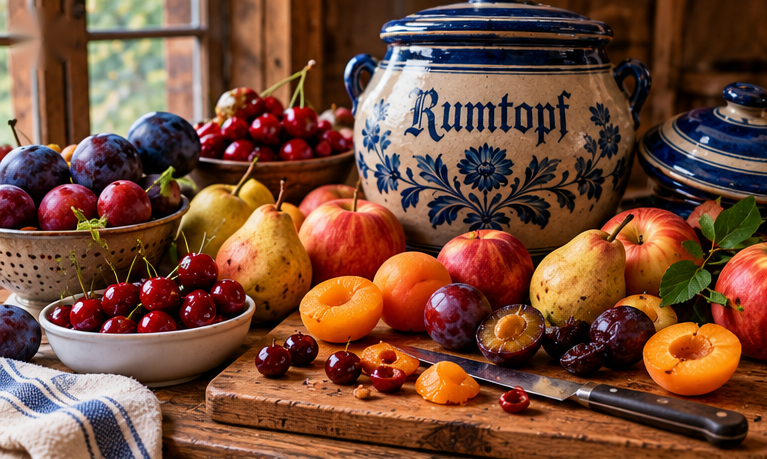
The beautiful ceramic containers traditionally used for Rumtopf are often substantial, generously rounded crocks with fitted lids. Some are decorated with the word Rumtopf across the front.
Although you can prepare a fresh batch in a suitable food-safe glass container, a traditional glazed stoneware Rumtopf makes the whole experience especially charming.
How to Make Rumtopf: Traditional German Christmas Fruit
This is a practical, smaller-batch adaptation of established German Rumtopf proportions. It uses approximately two parts prepared fruit to one part sugar by weight, plus enough strong rum to keep the fruit submerged.
Preparation time: Approximately 30 minutes, plus resting time
Maturation time: At least 4 weeks; 6–8 weeks is preferable for fuller flavour
Yield: Approximately 12 small dessert servings, depending on portions and the amount of rum used
Equipment: Food-safe glass jar or glazed ceramic crock with lid, approximately 2.5–3 litres in capacity
Choosing a Traditional Rumtopf Crock
Although you can make Rumtopf in a suitable food-safe glass container, there’s something particularly charming about preparing it in a traditional German stoneware Rumtopf.
Look for a generously sized, food-safe glazed ceramic crock with a fitted lid and an intact interior glaze. Choose a capacity suitable for the amount of fruit you’re preparing, remembering that the rum must completely cover the fruit.
We’ll also be featuring suitable Rumtopf crocks and traditional food-preserving equipment in the Cooking With Kimberly shop.
Ingredients for Traditional Rumtopf
- 1 kg (2.2 lb) prepared mixed fruit, such as plums, cherries, peaches, nectarines, apricots, and firm pears
- 500 g (about 2 1/2 cups) granulated sugar, measured by weight for best accuracy
- Approximately 750 ml to 1 litre of rum, around 54% alcohol by volume, or enough to cover all the fruit by approximately 1 cm (about 1/2 inch)
- Optional: 1 small cinnamon stick
- Optional: A small piece of vanilla bean
Important: The rum quantity is approximate. Fruit shape, moisture, and container dimensions affect how much liquid is required. The fruit must remain completely submerged. Choose rum with an alcohol strength appropriate to established Rumtopf recipes rather than substituting ordinary 40% rum and assuming the preservation properties are identical.
Choosing the Best Fruit for Rumtopf
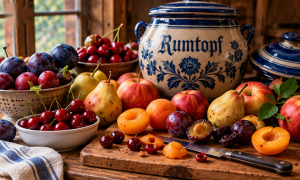
For this recipe, choose ripe, fresh, sound fruit without mould, bruised or spoiled areas, or signs of deterioration.
Some wonderful choices include:
- Sweet or sour cherries, pitted
- Plums and prune plums
- Peaches and nectarines
- Apricots
- Firm pears
- Strawberries, when in season
- Raspberries and other suitable berries, used carefully because they soften easily
For an autumn Rumtopf, plums, pears, and other available firm fruits make a lovely starting point. When using frozen fruit, follow a recipe specifically formulated for that variation rather than assuming the same storage conditions will apply.
How to Prepare Traditional German Rumtopf Step by Step
Step 1: Prepare the Rumtopf Container
Choose a thoroughly clean, food-safe glass jar or glazed stoneware crock with a suitable lid.
Wash and rinse the container carefully, following the manufacturer’s cleaning instructions, and allow it to drain thoroughly.
If using vintage pottery, make certain the interior glaze is intact and suitable for food contact. Antique decorative ceramics and damaged glazes should not be assumed safe for prolonged contact with acidic fruit and alcohol.
Step 2: Wash, Dry, and Prepare the Fruit
Wash the fresh fruit carefully and dry it thoroughly.
Remove stems, leaves, pits, and cores as appropriate. Cut large fruits into uniform, manageable pieces.
Use smaller cherries whole after pitting, and cut peaches, nectarines, pears, and plums into suitable wedges or chunks.
Avoid overripe fruit that is already breaking down. Firmer fruit generally retains a more appealing texture during the infusion period.
Step 3: Combine the Fruit and Sugar
Place the prepared fruit in a clean mixing bowl and sprinkle with the measured sugar.
Gently toss to distribute the sugar evenly, taking care not to crush softer fruits.
Allow the mixture to rest for approximately 30–60 minutes so that the fruit releases some juice and the sugar begins to dissolve.
This step follows the general preparation approach used in many traditional German Rumtopf recipes.
Step 4: Transfer the Fruit to the Crock
Carefully transfer the sweetened fruit and its juices into your prepared Rumtopf container.
If using cinnamon or vanilla, add the chosen flavouring now.
Leave adequate space at the top of the container for the rum and any displacement caused by the fruit.
Step 5: Cover the Fruit with Strong Rum
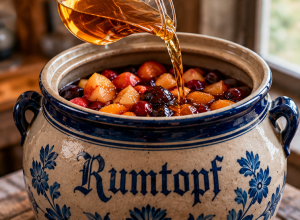
Pour in enough strong rum to cover the fruit completely, ideally by approximately 1 cm (about 1/2 inch).
The quantity needed will vary, so don’t rely solely on a fixed volume of rum.
If the fruit floats, use a thoroughly cleaned, food-safe weight or suitably sized plate to keep it beneath the surface.
The fruit must remain submerged. Exposed pieces can spoil, so check the mixture regularly.
Step 6: Cover and Allow the Rumtopf to Mature
Cover the container with its lid and store it in a consistently cool, dark place, away from heat and direct sunlight.
Traditional German recipes often use a cool cellar or pantry. For a modern home kitchen, particularly if storage temperatures fluctuate, refrigeration is the more conservative choice, provided the container is suitable for it.
Check the Rumtopf regularly with clean utensils. Make sure the fruit remains submerged, and top up with the same strength of rum if needed.
Allow a minimum of approximately four weeks for flavour development. Six to eight weeks, or longer within the appropriate storage conditions, can produce a more developed result.
Step 7: Taste and Serve at Christmas
Once the fruit has matured, use a clean spoon to remove a small serving.
Enjoy the richly flavoured fruit with ice cream, custard, pudding, or another favourite Christmas dessert.
The soaking liquid can also be used sparingly as a flavourful adult dessert drizzle or as an ingredient in cocktails.
Remember: Both the fruit and the liquid contain alcohol.
Can You Make Rumtopf in October for Christmas?
Absolutely! Although the traditional seasonal method often begins much earlier in the year, an October batch can still develop lovely flavours before Christmas.
If you start in mid-October, you’ll have approximately ten weeks until December 25.
For an autumn preparation, consider plums, pears, and other suitable firm fruits that are available and in good condition.
Rather than trying to recreate an entire summer’s harvest in one afternoon, prepare a smaller batch using the fruit available now.
Allow at least four weeks, preferably six to eight weeks, for the flavours to mingle before serving.
It’s a wonderful way to begin your Christmas kitchen preparations while the autumn harvest is still on your mind.
How to Make Rumtopf Throughout the Growing Season
In the more traditional approach, Rumtopf becomes an ongoing seasonal project.
Different fruits are added as they ripen, with proportional amounts of sugar and additional strong rum.
A typical fruit calendar might look like this:
- Late spring and early summer: Strawberries and early berries
- Early to midsummer: Cherries, apricots, and raspberries
- Late summer: Peaches, nectarines, and plums
- Autumn: Pears, late plums, and other suitable firm fruits
Whenever adding more fruit, use the same established sugar-to-fruit proportions and add enough strong rum to submerge everything again.
Always use clean utensils and sound fruit. Do not treat a traditional seasonal Rumtopf as a reason to replenish the same mixture indefinitely without assessing its condition and storage safety.
Our Family Rumtopf: A No-Added-Sugar Tradition
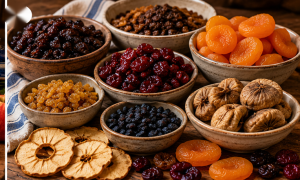
Our own family prepared Rumtopf somewhat differently from the conventional German method described above.
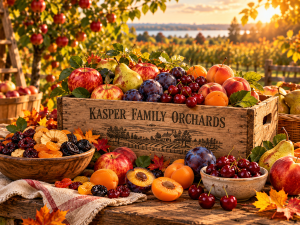
Much of our fruit came from Kasper Family Orchards, my Oma and Opa’s farm in Niagara-on-the-Lake, Ontario.
We had access to beautiful seasonal stone fruits, including cherries, plums, apricots, peaches, and nectarines, along with apples and pears.
We also used plenty of dehydrated fruit, including raisins, dried apricots, cherries, blueberries, figs, peaches, pears, and even kiwi.
My mother, Ingrid, recently confirmed that our family did not add sugar to the Rumtopf.
Oma and Opa raised nine children, and money was scarce. They weren’t going to use ingredients unnecessarily, especially when so much concentrated sweetness came from the dried fruit.
That no-added-sugar preparation is an important part of our culinary family history, but it should not be treated as interchangeable with the measured traditional recipe above.
The Rumtopf That Crossed an Ocean: Our Family’s Christmas Fruit Tradition
There’s a remarkable story behind the beautiful stoneware Rumtopf that inspired my love of this traditional German preparation.
When my Oma and Opa fled Russia and immigrated to Canada in 1924, they brought their Rumtopf with them. That same magnificent stoneware crock became part of our family’s culinary traditions for generations.
It held fruit grown at Kasper Family Orchards, harvested by generations of our family, and prepared with care by Oma, Mom, and eventually me.
There’s even a little German song associated with it!
My Opa sang in a German choir and played guitar. Mom remembers him singing a playful little rhyme while Oma prepared the Rumtopf, and she recently helped me reconstruct the words from her childhood memories.
I’ve shared the complete story in a special Cooking With Kimberly Food Memories feature, including the crock’s extraordinary journey to Canada, the history of our family orchards, and Opa’s treasured little song.
Read The Rumtopf That Crossed an Ocean: Our Family’s Christmas Fruit Tradition »
For even more recipes, serving suggestions, and seasonal inspiration, explore all our Rumtopf articles on Cooking With Kimberly.
Food-safety distinction: The sugar content, fruit moisture, alcohol strength, and storage conditions all influence the stability of a preparation. Our family’s historical method has not been independently validated as a modern shelf-stable preserving recipe. If experimenting with a sugar-free version, use a separately developed and validated method rather than removing the sugar from this recipe and assuming the result will keep in the same way.
For the complete story of our magnificent family crock, the orchard harvests, and Opa’s German Rumtopf song, explore our newly published family-history feature on Cooking With Kimberly. You can find our Rumtopf articles here.
How to Serve Rumtopf at Christmas
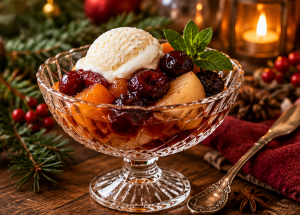
Once your Rumtopf is ready, there are so many wonderful ways to enjoy it!
- Vanilla or rum-raisin ice cream: Spoon a little fruit and liquid over a scoop of ice cream.
- Warm custard: Pair the rum-soaked fruit with a rich vanilla custard.
- Rice pudding: Add a spoonful to a creamy bowl of rice pudding.
- Tapioca: Enjoy the fruity contrast with delicate tapioca pudding.
- Pies and pastries: Serve Rumtopf alongside slices of pie or pastry-topped desserts.
- Cakes and cheesecake: Use a small portion as an elegant adult dessert topping.
- Christmas charcuterie board: Offer a clearly labelled adults-only bowl of Rumtopf with aged cheeses, cured meats, crackers, and nuts.
- Fruit desserts: Serve it separately alongside German-style fruit stew such as Pluma Moos.
- Fruit leather experiments: Rumtopf fruit could inspire an adult-only dehydrated fruit leather, although alcohol removal and storage safety must not be assumed without testing.
- Holiday cocktails: Use a little of the fruit and rum-infused liquid in an original Christmas cocktail.
One cocktail idea I’m particularly excited about developing is The Rumtopf Royale—a festive, shaken drink featuring rum-infused fruit and complementary flavours.
We’ll share the complete recipe separately once we’ve developed and tested it.
Rumtopf Food Safety, Alcohol Strength, and Storage
When learning how to make Rumtopf, ingredient quality and storage conditions matter just as much as flavour.
- Use suitable alcohol: Traditional German Rumtopf recipes commonly specify rum around 54% alcohol by volume. Do not substitute a lower-strength spirit while assuming identical preservation performance.
- Use clean, food-safe containers: Avoid cracked, damaged, or questionable antique glazes.
- Select sound fruit: Discard mouldy, damaged, or deteriorating ingredients before preparation.
- Keep fruit submerged: Maintain enough rum above the fruit throughout maturation.
- Keep storage temperatures cool: Refrigeration offers a conservative option when a consistently cool cellar is unavailable.
- Check for spoilage: If mould, unexpected fermentation, gas production, unusual odours, or other deterioration develops, discard the mixture. Do not taste it to determine whether it is safe.
- Do not assume indefinite shelf life: A home-prepared Rumtopf is not equivalent to a commercially validated shelf-stable preserve.
- Serve responsibly: The fruit retains alcohol. Keep Rumtopf away from children and pets and clearly identify it when serving guests.
Even gently heating the fruit does not reliably eliminate all the alcohol.
For traditional proportion and preparation references, see Dr. Oetker’s German Rumtopf recipe and Steinzeug-Schmitt’s traditional stoneware Rumtopf guide.
Start a German Rumtopf Christmas Tradition
There’s something wonderfully satisfying about preparing a seasonal dessert weeks before you plan to serve it.
As the fruit rests, the flavours develop into something rich and special, ready to accompany your favourite Christmas desserts.
For me, Rumtopf will always represent much more than a preserved fruit preparation.
It reminds me of Oma and Opa, the orchards where our family worked, the fruit cellar, and the beautiful old stoneware crock that became part of my own kitchen traditions.
Whether you’re discovering Rumtopf for the first time or reviving an old family custom, I hope you’ll enjoy exploring this delightful German Christmas preparation.
Be a Champion in Your Kitchen, and Eat Deliciously!
More German Food Recipes on Cooking With Kimberly
Looking for more German culinary traditions, recipes, and cooking inspiration? Explore our complete collection of German dishes and reviews.
Browse Our German Food Recipes Category »
Watch German Recipes + Reviews on YouTube
Enjoy our German Recipes + Reviews video playlist below. Use the YouTube player’s playlist controls to choose another video.
View the Complete German Recipes + Reviews Playlist »
Recipe development note: This fresh-batch recipe is an adaptation of established German Rumtopf proportions and preparation methods. It has not yet been independently kitchen-tested by Cooking With Kimberly. Actual rum requirements, fruit texture, maturation, and safe storage conditions depend on the ingredients and equipment used.